

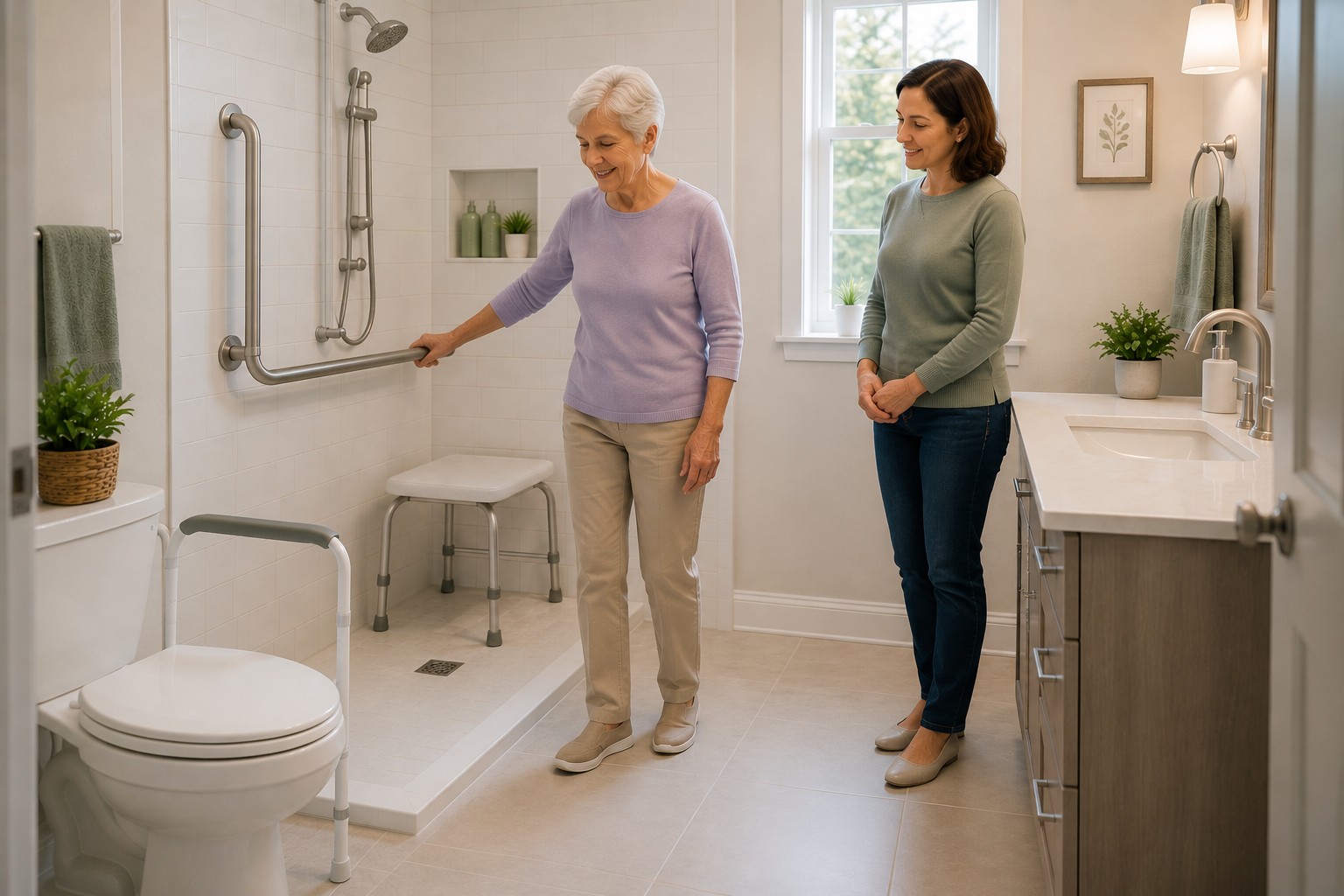
The bathroom is one area of the home that deserves particular attention when you are caring for an elderly parent.
Wet surfaces, getting into and out of a bath or shower, sitting down and standing from the toilet, and moving around a small space can become more difficult when someone’s balance, strength or mobility changes.
However, making a bathroom safer does not mean filling it with equipment your parent may not need. The right changes depend on how your parent uses the bathroom, what they find difficult and whether they have any particular mobility or health concerns.
As a caregiver, you can identify obvious hazards and talk with your parent about the tasks they find difficult. If their needs are more complex, an occupational therapist or other appropriately trained professional can assess the home and recommend suitable adaptations.
1. Start by Watching How Your Parent Uses the Bathroom
Before buying equipment, look at the activities your parent performs every day.
Consider whether they can comfortably:
- Get into and out of the bath or shower.
- Stand while showering.
- Sit down and stand from the toilet.
- Reach toiletries and towels.
- Turn taps on and off.
- Move around the bathroom without reaching for furniture or fittings.
- Use the bathroom safely during the night.
Ask your parent which tasks they find difficult.
You may notice that they hesitate before stepping into the shower, reach for the sink when standing from the toilet or avoid having a bath because getting out has become difficult.
These observations can help you identify where support may actually be needed.
2. Reduce the Risk of Slipping
For more ways to reduce fall hazards throughout the home, read my guide on how to prevent falls at home for an elderly parent.
Water on a bathroom floor can create a slipping hazard.
Clean up spills and standing water rather than leaving them until later.
A suitable non-slip mat may also be useful in the bath or shower.
Be careful with loose bathroom rugs and mats. Something intended to provide comfort can become a trip hazard if it moves, curls at the edges or catches someone’s foot.
Look at the bathroom floor from your parent’s perspective. Consider whether there are loose items, cables, scales, laundry baskets or other objects in their usual walking route.
Keeping the floor clear can make it easier to move around.
3. Consider Properly Positioned Grab Rails
If your parent reaches for the wall, sink, towel rail or another bathroom fitting for support, it may indicate that they need a safer way to steady themselves.
Properly positioned grab rails can help some people when getting into or out of the bath or shower or when using the toilet.
However, grab rails should suit the person and the task.
Do not assume that placing a rail wherever there is available wall space will make the bathroom safer. The position and type of rail can matter.
Also, do not assume that a towel rail is suitable for supporting someone’s body weight.
If you are unsure where a grab rail should go, consider asking for a professional home assessment rather than guessing.
4. Think About Getting Into and Out of the Bath
A traditional bath can become difficult to use if your parent has reduced strength, flexibility or balance.
Pay attention to whether they can step over the side of the bath and get back out comfortably.
There are different types of bathing equipment and adaptations available, including bath lifts, grab rails and other equipment.
However, the appropriate solution depends on the individual.
Do not assume that your parent needs a walk-in bath or a completely new bathroom simply because getting into the bath has become difficult.
An occupational therapist can look at how your parent currently manages and recommend appropriate equipment or adaptations.
5. Make Showering Easier Where Necessary
Standing for the entire duration of a shower may become difficult for someone with reduced strength, balance or stamina.
Depending on individual needs, suitable shower seating may make washing easier.
However, avoid placing an ordinary household chair or unstable stool in the shower.
Bathroom equipment should be designed for its intended use and suitable for the individual.
If your parent needs substantial support when showering or transferring, seek professional advice about appropriate equipment rather than relying on a generic product recommendation.
6. Look at Toilet Access
Getting on and off the toilet can become difficult when leg strength, joint movement or balance changes.
Watch whether your parent struggles to lower themselves, needs several attempts to stand or pulls on nearby furniture or bathroom fittings.
Depending on individual needs, equipment such as an appropriate toilet frame or raised toilet seat may be considered.
However, these products are not automatically suitable for everyone.
If your parent is having significant difficulty using the toilet independently, an occupational therapist can assess the problem and recommend suitable equipment.
7. Improve Bathroom Lighting
Good lighting can make it easier to see the floor, bathroom fittings and changes in surface level.
Make sure the bathroom has adequate lighting and that switches are easy to reach.
Also consider the route to the bathroom.
If your parent gets up during the night, check whether the bedroom, hallway and bathroom can be adequately lit before they start walking.
A bedside light or suitable night lighting may make the route easier to see.
If your parent is experiencing changes in their eyesight, encourage them to discuss this with an appropriate eye-care professional rather than relying solely on brighter lighting.
8. Keep Toiletries Within Easy Reach
Look at where soap, shampoo, towels, toilet paper and other frequently used items are stored.
Your parent should not routinely need to stretch excessively, climb or reach into an awkward position to get everyday items.
Move frequently used products somewhere accessible.
At the same time, avoid cluttering the edges of the bath, shower floor or areas around the toilet.
The aim is to keep necessary items accessible without creating additional obstacles.
9. Consider Taps and Controls
Hand strength and dexterity can change with age or because of conditions affecting the hands and joints.
Ask your parent whether they find the taps difficult to turn.
There are bathroom products designed to make taps and other controls easier to operate.
However, before replacing fittings, identify what your parent actually struggles with.
Sometimes a relatively small adaptation may solve the problem.
An occupational therapist can also advise on equipment for everyday tasks if hand function has become a significant difficulty.
10. Think About Bathroom Doors and Access
Consider what would happen if your parent fell or became unwell inside the bathroom.
The layout of the room and the direction in which the door opens may affect access during an emergency.
Do not make structural changes yourself without appropriate advice.
If access is a particular concern, discuss it during a home assessment so that the bathroom can be considered as part of the person’s overall needs.
Also avoid creating a bathroom that becomes difficult to navigate because too much equipment has been added.
Your parent still needs enough clear space to move around comfortably.
11. Do Not Buy Equipment Simply Because It Is Marketed for Elderly People
There is a large range of bathroom safety equipment available, but a product being described as suitable for seniors does not mean it will suit your parent.
Before buying something, consider:
- What specific problem does it solve?
- Can your parent use it comfortably?
- Is it suitable for their height and mobility?
- Does it fit the bathroom properly?
- Will it remain stable during use?
- Does it interfere with another activity?
- Would professional assessment be more appropriate?
This is particularly important for equipment that your parent will rely on for support.
The goal should be to solve an identified problem rather than adding equipment simply because it appears on a bathroom safety checklist.
12. Consider a Professional Home Assessment
If your parent struggles with bathing, toileting or moving around the bathroom, you can ask your local council’s adult social services department about a home assessment.
An occupational therapist may visit the home, discuss the activities your parent finds difficult and look at potential adaptations together.
Possible recommendations can include equipment or adaptations such as grab rails, bathing equipment or changes to make everyday activities easier.
This can be particularly useful when your parent has experienced falls, has significant balance or mobility difficulties, or needs substantial bathroom adaptations.
In England, some equipment and smaller home adaptations may be available through local authority support, depending on eligibility and circumstances.
For more information, read the NHS guidance on home adaptations and assessments.
13. Keep Your Parent Involved
Bathroom safety is personal.
Your parent may not want equipment installed without being consulted, particularly if they feel that changes make their bathroom look clinical or suggest that they are losing independence.
Talk about the difficulty rather than starting with the equipment.
For example, ask:
“Do you find getting out of the shower more difficult than it used to be?”
or:
“Is there anywhere you feel you need something to hold onto?”
Then look at possible solutions together.
Unless there is an immediate safety concern, involving your parent in decisions can help you make changes that they are comfortable using.
14. Know When the Problem Goes Beyond the Bathroom
If your parent has become unsteady more generally, you may also find my guide to helping an elderly parent with balance problems at home useful.
Sometimes a bathroom difficulty is part of a wider change in mobility or balance.
For example, if your parent suddenly starts struggling to stand from the toilet, frequently loses their balance, becomes dizzy or has experienced falls elsewhere in the home, changing the bathroom alone may not address the underlying problem.
Encourage them to discuss new or worsening mobility, balance or dizziness with an appropriate healthcare professional.
If falls are becoming a concern, a broader falls assessment or home-hazard assessment may also be appropriate.
For a wider look at supporting your parent at home, read how to help an elderly parent live independently and safely at home
Practical Caregiver Tip
Do not start by buying a shower chair, grab rails and several other products.
Instead, ask your parent to talk you through how they normally use the bathroom.
Look at getting through the door, using the toilet, getting into the bath or shower, washing, drying and leaving the room.
Write down the specific points where they experience difficulty.
You can then separate simple problems, such as moving toiletries somewhere easier to reach, from problems that may benefit from professional assessment, such as difficulty transferring into a bath or repeatedly needing support when standing.
This helps you choose changes based on your parent’s actual needs rather than assumptions about what an elderly person’s bathroom should contain.
Final Thoughts
Making a bathroom safer for an elderly parent is not about removing every possible risk or installing as much safety equipment as possible.
Start with how your parent actually uses the room.
Keep the floor clear, consider slipping hazards, make sure lighting is adequate and keep frequently used items accessible.
If your parent needs physical support when bathing, showering or using the toilet, suitable equipment or adaptations may help. However, the right solution depends on the individual.
Where needs are more complex, consider asking for a home assessment rather than trying to choose every adaptation yourself.
Most importantly, involve your parent.
A safer bathroom should support their independence and make everyday activities easier, rather than making decisions about their home without them.
This guide provides general caregiving and home-safety information. It does not replace an individual assessment from an occupational therapist, physiotherapist, GP or another appropriate professional.