

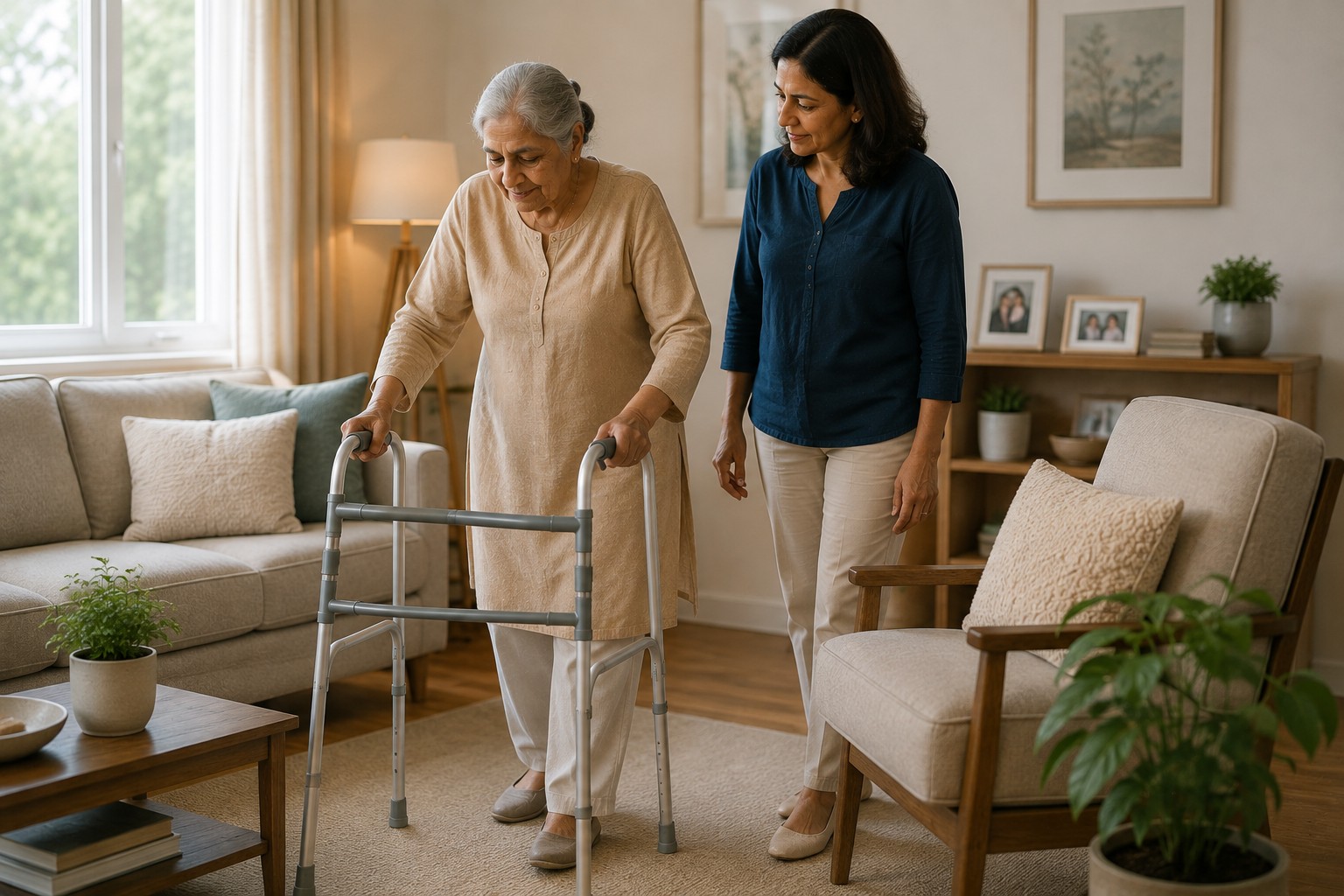
Limited mobility does not always look the same from one day to the next.
I see this with my own mother. She has several health problems that affect her mobility, including osteoporosis and problems affecting her knees and back. She also experiences periods when pain and muscle spasms make moving around much more difficult.
On her better days, she can walk without a walking frame. On difficult days, her mobility can become much more limited.
Because her abilities can change, I have learned that supporting her mobility is not simply about deciding whether she can or cannot walk independently. I need to pay attention to how she is managing on that particular day and make sure she has appropriate support available when she needs it.
Caring for an elderly parent with limited mobility has taught me that the amount of support someone needs can change from one day to the next.
Every older person’s circumstances are different. This guide shares what I have learned as a caregiver alongside practical guidance for supporting an elderly parent whose mobility is limited or varies from day to day.
1. Caring for an Elderly Parent With Limited Mobility Can Vary Day to Day
One of the most important things I have learned is not to assume that yesterday’s level of mobility will necessarily be the same today.
My mother has good days when she can move around much more independently. At other times, pain and flare-ups can significantly reduce what she is comfortable doing.
This means I pay attention to how she is moving rather than assuming that because she managed something yesterday, she should be able to do the same thing today.
For another parent, the reasons for changing mobility may be completely different.
If you notice a significant or unexplained change in your parent’s ability to walk, stand or move around, it is worth discussing it with an appropriate healthcare professional.
2. Support Independence Where It Is Safe
Limited mobility does not necessarily mean an older parent needs help with everything.
When my mother is having a good day, she can walk without a frame. I do not want to take that independence away from her simply because she sometimes has more difficult days.
Instead, I try to think about what she can manage at that particular time and where she genuinely needs assistance.
You can take a similar approach with your parent.
Consider whether they can:
- Get out of bed safely.
- Stand from their usual chair.
- Walk to the bathroom.
- Use the toilet independently.
- Manage stairs.
- Get in and out of the shower.
- Prepare something to eat or drink.
- Move around the home without relying on unstable furniture.
The level of support may need to change as their mobility changes.
3. Make Difficult Days Easier
When mobility becomes more restricted, everyday tasks can require considerably more effort.
Think about what your parent needs within easy reach.
This might include:
- Their phone.
- Water.
- Glasses.
- Medication they manage themselves.
- A personal alarm, if they use one.
- Frequently used personal items.
- An appropriate mobility aid, if one has been recommended for them.
The NHS advises people at risk of falls to consider carrying a mobile phone or using a personal alarm so they can call for help if necessary.
However, try not to assume that staying in bed all day is automatically the safest response whenever mobility becomes difficult.
If your parent is spending substantially more time in bed than usual, cannot manage their normal activities or has experienced a significant change in mobility, seek appropriate professional advice.
4. Think Carefully About Stairs
Stairs can become particularly difficult when someone’s mobility varies.
In my mother’s case, we have a stairlift. She uses it when her mobility is reduced rather than struggling with the stairs.
For our family, the stairlift provides a practical way for her to move between floors when using the stairs normally would be difficult.
However, I would not suggest that every older person with limited mobility needs a stairlift.
The appropriate solution depends on the person’s abilities, their home and the reason they are having difficulty.
The NHS lists stairlifts and additional banisters among possible home adaptations and recommends a home assessment when someone needs help with everyday activities or is worried about falling. An occupational therapist can assess the home and discuss appropriate changes.
5. Do Not Assume a Walking Aid Is Always or Never Needed
Walking aids can be useful, but the appropriate aid depends on the individual.
The NHS explains that walking sticks can provide additional support and help with balance, while walking frames provide more support than sticks. It also recommends getting advice about matters such as the correct height and appropriate type of aid.
This is particularly relevant when someone’s mobility varies.
My mother does not always need a walking frame. On her better days, she can walk without one.
Her experience has taught me not to think of mobility aids as an all-or-nothing decision.
However, whether someone should use a stick, frame, rollator or another aid is not something I would decide for another person based on my mother’s experience.
A physiotherapist, occupational therapist or other appropriate professional can assess mobility and recommend suitable equipment.
6. Be Careful With Knee Supports and Other Wearable Supports
My mother sometimes uses knee support as part of managing her mobility.
However, I would be careful about presenting a knee support as something that prevents falls.
That is too strong a claim.
Whether a brace or support is appropriate depends on the individual and the reason it is being used.
If your parent has significant knee problems, instability or difficulty walking, ask an appropriate healthcare professional whether a support is suitable and how it should be used.
Personal experience can tell you what works for your family. It cannot establish what another person should use.
7. Keep Walking Routes Clear
When someone’s mobility is already limited, unnecessary obstacles can make getting around the home harder.
For a wider room-by-room review, you can use my home safety checklist for an elderly parent.
The NHS recommends reducing common trip hazards such as clutter, loose wires and rugs for people at risk of falls.
Look particularly at the routes your parent uses most frequently:
- Bed to bathroom.
- Bedroom to stairs.
- Chair to kitchen.
- Hallway to front door.
Make sure commonly used routes are clear and adequately lit.
If your parent uses a walking aid, consider whether the furniture arrangement gives them enough room to use it properly.
8. Pay Attention to Chairs and Transfers
Walking is only one part of mobility.
Watch how your parent manages transitions such as:
- Getting out of bed.
- Standing from a chair.
- Sitting down.
- Getting on and off the toilet.
- Getting into and out of a car.
- Entering and leaving the bath or shower.
Sometimes these movements reveal difficulties that are less obvious when watching someone walk.
For example, repeatedly pulling on unstable furniture to stand could create an additional hazard.
If transfers are becoming difficult, an occupational therapist or physiotherapist may be able to assess what is happening and recommend appropriate techniques or equipment.
9. Make the Bathroom Easier to Manage
Bathrooms can become particularly challenging when mobility is reduced.
Consider whether your parent can comfortably get to the toilet, stand from it, enter and leave the bath or shower, and reach the things they need.
Depending on an individual’s needs, adaptations might include grab rails, bathing equipment or other changes.
The NHS lists grab rails, bath lifts and walk-in showers among examples of home adaptations.
However, I would avoid buying substantial mobility equipment simply because it is marketed for older people.
Identify the difficulty first. Then find an appropriate solution.
10. Do Not Encourage Difficult Tasks Just for the Sake of Independence
Supporting independence does not mean encouraging a parent to attempt something they are currently struggling to do.
The NHS advises people at risk of falls not to attempt difficult tasks such as lifting or reaching when they need help.
This is something I find particularly relevant when mobility varies.
A task that is manageable on a good day may be much harder on another day.
Instead of focusing on what your parent “should” be able to do, consider what they can manage safely and comfortably at that time.
11. Consider a Professional Mobility Assessment
If your parent is increasingly struggling to walk or manage everyday activities, professional assessment can be valuable.
A physiotherapist may assess mobility and provide appropriate advice about movement, strength, balance and walking aids. An occupational therapist can look at how your parent’s health affects everyday activities and whether changes to the home or equipment may help. NHS services may also provide some walking aids.
In England, you can also ask your local council for a home assessment if your parent needs help with everyday activities or you are worried about falls. The NHS states that the home assessment itself is free.
For further information, read the NHS guidance on home adaptations.
12. Know When a Change Needs Medical Attention
If your parent has become increasingly unsteady, you may also find my guide to helping an elderly parent with balance problems at home useful.
Do not assume every deterioration in mobility is simply part of getting older or part of an existing condition.
The NHS advises seeing a GP if someone is worried about their balance or mobility or has experienced a fall.
If your parent’s mobility changes significantly, they develop new symptoms, or you are concerned about their ability to move safely, seek appropriate medical advice.
Existing diagnoses do not necessarily explain every new mobility problem.
13. Prepare for Falls Without Assuming They Will Happen
For more practical ways to reduce hazards around the home, read my guide on how to prevent falls at home for an elderly parent.
Even with sensible precautions, falls cannot always be prevented.
If your parent has mobility problems, consider how they would get help if they fell.
A mobile phone or personal alarm may be useful for some people. The NHS includes both among its falls-prevention advice.
It is also worth knowing what to do after a fall.
The NHS advises calling 999 when someone who has fallen may have injured their head, back, neck or hip, or cannot get up. NHS 111 is recommended when someone may be injured, in pain or unwell following a fall.
For more information, read the NHS guidance on falls.
14. Keep Your Parent Involved
Mobility aids and home adaptations affect how your parent lives in their own home.
Talk with them before making changes where possible.
Ask questions such as:
- Which activities are becoming difficult?
- When do you feel least steady?
- Is there somewhere you regularly need support?
- Are the stairs becoming difficult?
- Is there equipment you find helpful?
- Is there equipment you dislike using?
- What would make getting around the house easier?
Your parent’s answers may reveal problems you would not notice simply by looking around their home.
Practical Caregiver Tip
One of the biggest lessons I have learned from caring for my mother is to respond to the day she is having.
Her mobility is not identical every day.
When she is moving well, I want her to retain the independence she is capable of. When pain or other symptoms reduce her mobility, I know she may need more support and may use adaptations such as her stairlift.
I have found it more useful to pay attention to what she can manage at that particular time rather than putting her permanently into either an “independent” or “limited mobility” category.
That is our family’s experience, not a rule for other caregivers.
If your parent’s mobility changes from day to day, professional advice can help you understand what support and equipment are appropriate for their individual circumstances.
Final Thoughts
Caring for an elderly parent with limited mobility can involve finding a balance between support, safety and independence.
My own experience with my mother has shown me that mobility can vary considerably. A difficult day does not necessarily represent what she can do every day, while a good day does not mean we should ignore the support she sometimes needs.
Look at what your parent can manage, keep frequently used areas accessible and consider appropriate home adaptations or mobility equipment when needed.
Most importantly, do not assume that every older person with limited mobility needs the same solution.
If your parent’s mobility is worsening, they are falling, or everyday activities are becoming difficult, involve appropriate healthcare or social care professionals.
The aim is to help your parent remain as independent as their circumstances allow while providing additional support when they need it.
This article provides general caregiving information and shares some of my own experience caring for my mother. It does not replace individual medical, physiotherapy, occupational therapy or other professional advice.